
Union County Court Records After Jail Arrest
A Union County arrest usually starts with law enforcement custody and booking at Union County Jail, operated by the Union County Sheriff's Office under Sheriff Eddie Cathey. The public P2C roster may show a name, primary charge, arrest date, booking agency, and details icon. That roster entry is not the final court record. After booking, a magistrate or judge handles immediate release questions, and the District Attorney reviews the case for prosecution.
Formal Union County court records after an arrest are handled through North Carolina court channels, not through the jail roster alone. The local courthouse is the Union County Judicial Center at 400 North Main Street in Monroe. The Judicial Branch lists the main number as (704) 698-3100 and public hours as Monday through Friday, 8:30 AM to 5:00 PM. Jail custody questions still belong with Union County Jail or the P2C Inmate Inquiry, while filed charges, court dates, dispositions, and certified copies belong with NC Courts or the clerk.
Use Union County jail inmate records for current custody and booking details. Use Union County jail mugshots for booking-photo access rules. Use court records after a jail arrest when the question is what charge the State filed, whether the charge changed, whether a warrant or order is connected to the case, or how the matter ended.
Find Court Records After an Arrest
The main online starting point is the NC eCourts Portal, which the NC Judicial Branch describes as a place to search court records, find hearing dates, and make payments. Public access can vary by case type, document type, and registration rules, so a missing document in the portal does not always mean no case exists. Older files, certified copies, local procedural questions, and records that are not online may require the Union County Clerk of Superior Court.
The NC Courts location pages also point users to court dates, court records, and online services. For a person arrested in Union County, search the court side by name, citation number, county, or case number when available. If the case number appears on a citation, warrant, bond paperwork, or release order, it is usually a better search key than a common name.
| NC eCourts Field | How It Helps | Union County Note |
|---|---|---|
| Name | Finds cases or court dates tied to a defendant name. | Try full legal name and spelling variants if the jail roster uses initials. |
| Citation Number | Useful for traffic and citation-based charges. | Use the number from citation paperwork or a Daily Bulletin entry when present. |
| County | Limits results to a selected county. | Choose Union County for cases filed in Monroe courts. |
| Case Number | Targets a known criminal file directly. | Often appears on court notices, warrants, and clerk paperwork. |
| Portal Action | Searches records, dates, and payments. | Some documents may still require clerk or Judicial Branch request routing. |
The NC eCourts Portal screenshot captured for this project shows the statewide entry point used for court records, dates, and payments.
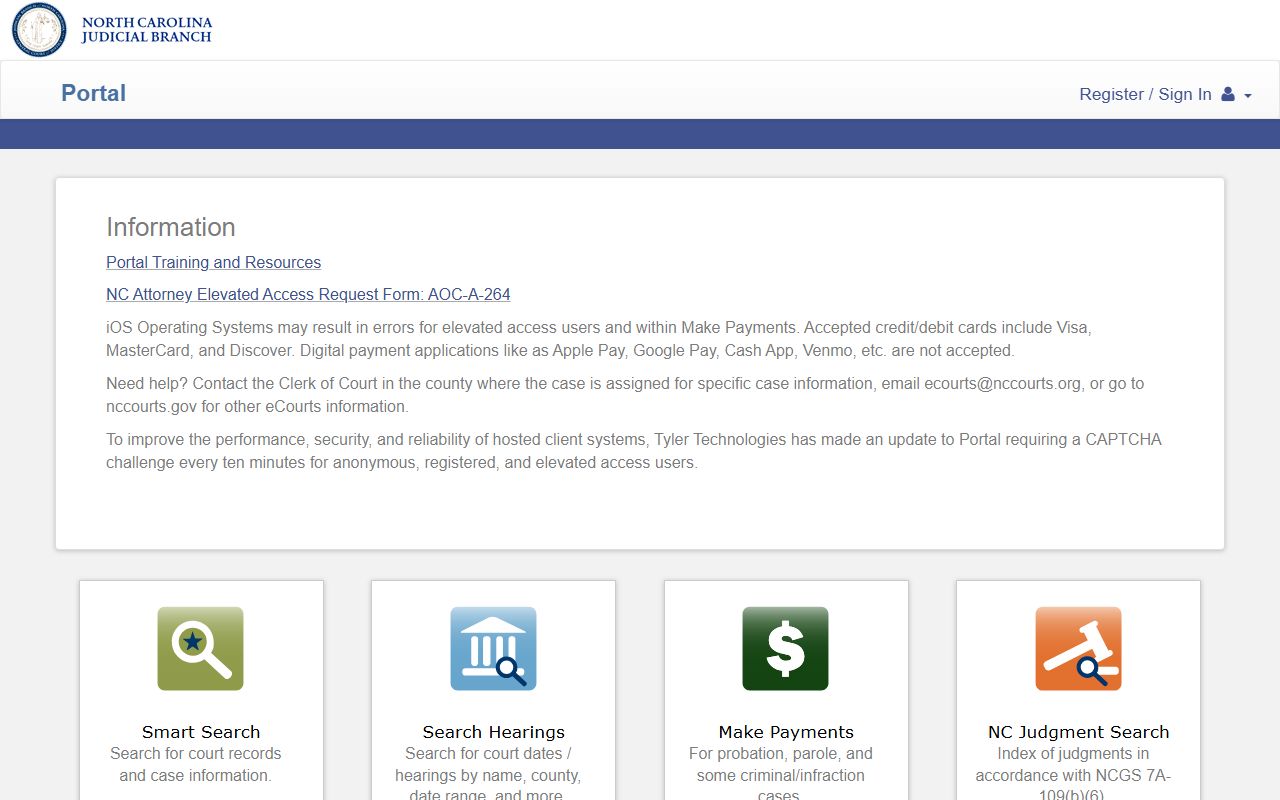
That portal is the court-side lookup channel; it should be checked alongside the Union County Sheriff P2C tools because roster charges and filed court charges can diverge.
Arrest, Booking, First Appearance, DA Review
The arrest-to-court path in Union County is sequential, but the public records do not all appear in one database. Booking at Union County Jail creates custody data. The jail intake process includes medical and mental-health screening, fingerprint submission, background checks, and classification. A first appearance or magistrate review addresses release conditions and immediate custody issues. The District Attorney then decides how the State will prosecute the criminal case.
- Arrest or service of a warrant brings the person into custody.
- Union County Jail records booking information and the P2C roster may show the primary charge.
- A magistrate or judge considers release conditions, bond, and any statutory hold.
- The Union County District Attorney reviews the matter for prosecution.
- The case appears in District or Superior Court depending on the charge and procedural stage.
Note: A P2C arrest date is a custody data point, while the court file tracks prosecution and case outcome.
Charging Records After an Arrest
Court records after a jail arrest depend on the charging document used. Union County P2C Daily Bulletin samples included arrest events and charge language, including felony and misdemeanor indicators, but the court file controls the prosecution record. A charge can start from an arrest warrant or complaint, move through a prosecutor-filed charging document, or proceed by indictment in felony matters.
| Charging Document | Who Uses It | What It Means |
|---|---|---|
| Criminal process or complaint | Law enforcement, magistrate, or prosecutor at an early stage. | Starts the custody and court path for many charges. |
| Information or prosecutor action | District Attorney's Office. | Reflects the State's decision about how to proceed on a charge. |
| Indictment or true bill | Grand jury and Superior Court process. | Common for many felony prosecutions and may supersede earlier charge wording. |
Union County is part of North Carolina Prosecutorial District 30. The North Carolina Conference of District Attorneys identifies Trey Robison as District Attorney. The DA represents the State, prepares criminal trial dockets, advises law enforcement, and prosecutes criminal cases filed in the district. The DA's office does not give legal advice to a charged person.
Charge Status in Court Records
Union County court records after an arrest may show several status changes before a case ends. The booking charge on the jail roster is often only the first public label. Prosecutors can amend charges, reduce them, dismiss them, seek indictment, or continue prosecution on a different theory. Each charge in a court case should be read separately because one count can be dismissed while another remains pending or results in conviction.
| Status | Meaning in the Court Record |
|---|---|
| Pending | The charge has not reached a final court disposition. |
| Amended | The charge wording, count, or legal theory changed from an earlier version. |
| Reduced | The case moved to a lesser charge than the original arrest or filing. |
| Dismissed | The charge ended without a conviction on that count. |
| Nolle prosequi or voluntary dismissal | The prosecutor declined to continue that charge. |
| Convicted | The court entered guilt by plea, verdict, or judgment. |
| Prayer for judgment continued | A North Carolina disposition that is not the same thing as an ordinary dismissal. |
Bond Records After a Jail Arrest
Bond and release information is part of the post-arrest path, but the top-level Union County P2C inmate table inspected did not show bond amount. A person searching court records after a jail arrest may need to combine the P2C roster, jail phone line, magistrate information, and court file. The Union County Jail number is (704) 283-3641, and the jail information line is also published as (704) 292-2600. The NC Courts contact directory lists Union County Magistrates at (704) 292-2746.
North Carolina Chapter 15A Article 26 governs pretrial release. Common release options include a written promise to appear, unsecured bond, secured bond, cash bond, surety bond, or a custody hold. A no-bond hold, domestic-violence timing rule, probation or parole matter, federal detainer, ICE issue, or another agency warrant can keep a person in custody even if one charge has a release condition.
- Secured bond
- Money, property, or a surety is required before release.
- Unsecured bond
- No money is paid up front, but the defendant can owe the amount after a violation.
- Custody hold
- Another warrant, detainer, court order, or agency issue prevents release.
Warrants and Orders Leading to Arrest
The Union County Sheriff's Office publishes a P2C Wanted List with last-name A through Z filters, a printable list link, and fields for name, charge, paper type, and agency. It is useful for active warrant or order research, but it is not a final court-history search. The page can show warrant for arrest, order for arrest, order to show cause, order for arrest failure to appear, and similar paper types.
Use the wanted list with caution. The research noted that age is based on the event date, not the current date. A warrant can be served, recalled, satisfied, or changed after a screenshot or search result is viewed. For current risk, court dates, or a possible active order, check NC eCourts, the Union County Clerk, the Sheriff's Office, or legal counsel before relying on an old web result.
The Union County P2C Wanted List screenshot shows the warrant and order table used for sheriff-side lookup.
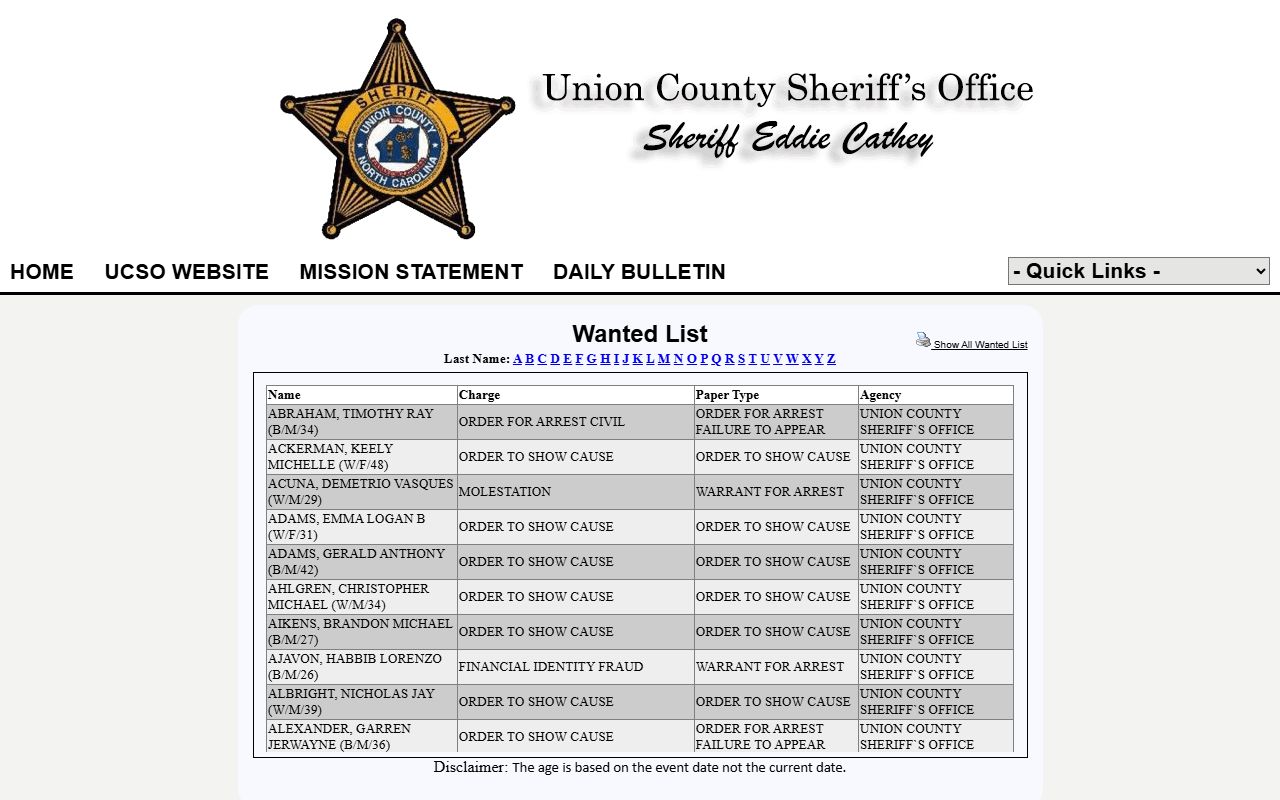
Those warrant and order records can explain why a person was booked at Union County Jail, but case outcome still has to be checked through the court record.
Charges vs. Convictions
An arrest and charge are accusations or process steps. A conviction is a court result. Union County court records after a jail arrest should be read with that distinction in mind, especially when the jail roster, Daily Bulletin, wanted list, and NC eCourts record use different labels.
| Question | Charge | Conviction |
|---|---|---|
| Stage | Accusation, warrant, complaint, indictment, or prosecutor filing. | Final guilt outcome by plea, verdict, or judgment. |
| Proof level | Can begin with probable cause or formal charging process. | Requires plea or proof beyond a reasonable doubt. |
| Where seen | P2C, warrant records, court filings, and calendars. | Court disposition, judgment, and sometimes NC DAC after sentencing. |
| Public meaning | Does not prove guilt. | Reflects a court outcome unless later vacated or expunged. |
Sealed and Expunged Court Records After Arrest
North Carolina public-record rules begin with broad access, but not every court, jail, or law-enforcement record remains public forever. G.S. 132-1 defines public records broadly, while G.S. 132-1.4 treats criminal investigation and criminal intelligence records differently. G.S. 15A-145.5 provides expunction eligibility for certain nonviolent misdemeanors and felonies. Official expunction petitions also instruct the petitioner to list arresting agencies and other agencies with records so orders can be routed if granted.
| Issue | Sealed | Expunged |
|---|---|---|
| Public visibility | Hidden or restricted from ordinary public view by law or order. | Removed from public access under an expunction order. |
| Agency access | Some official access may remain depending on the law. | Access after expunction is limited by the order and statute. |
| How it happens | Through a specific statute, rule, or court order. | Through the North Carolina expunction petition and order process. |
| Union County routing | Check the clerk or custodian for the affected record. | Follow the court order and named agency distribution. |
Note: Do not treat a dismissed charge as automatically expunged; the court-clearing process is separate.
Public Records Routing
Different Union County records have different custodians. Sheriff booking records, arrest reports, Daily Bulletin data, wanted-list entries, and booking-photo requests should be routed through the sheriff or Union County public-record channels. Court case records, certified court copies, and Judicial Branch administrative records should be routed through NC Courts. Prisoner records after a state-prison transfer belong with the NC DAC Offender Public Information search.
Union County's NextRequest portal is the local public-record request channel when a sheriff or county record is not online. The county policy says requests are processed promptly and generally in first-come, first-served order. The county does not have to create a record that does not exist. Under G.S. 132-6.2, Union County may charge a special service fee after the first four hours of collective staff time, and the local policy lists $40 per hour for time beyond that threshold.
- Court case lookup: use NC eCourts and the Union County Judicial Center for filed charges, court dates, dispositions, and certified copies.
- Sheriff records: use P2C Inmate Inquiry, Arrest / Incident Search, Daily Bulletin, Wanted List, jail phone lines, and Union County NextRequest.
- After transfer: use NC DAC for state prison or supervision records, BOP for federal custody, ICE ODLS for immigration custody, and VINELink for custody notifications.
The Union County court contact directory screenshot shows the local clerk, magistrate, District Attorney, and specialty court contacts.
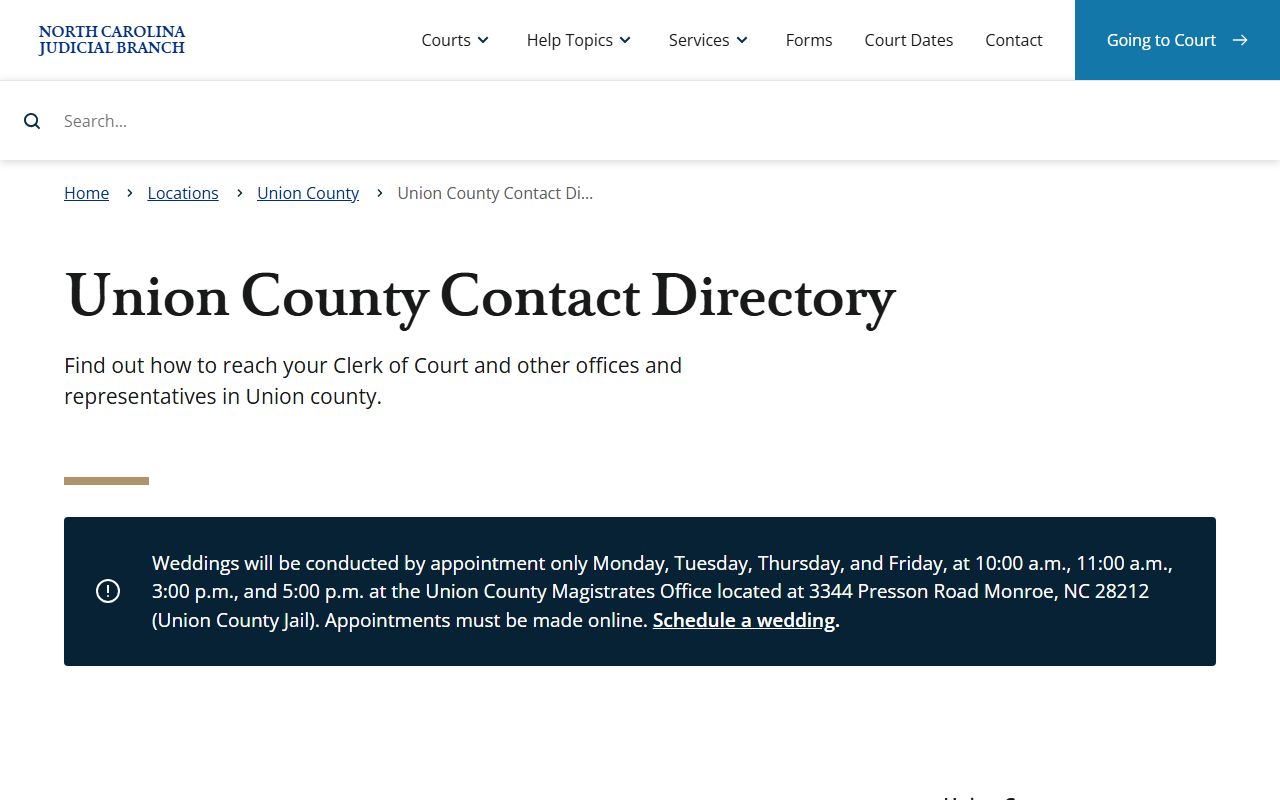
That directory is useful when a court record after arrest requires local clerk, magistrate, or prosecutor routing instead of a jail-record request.
Important: This site is not a consumer reporting agency and cannot be used for employment, tenant, credit, insurance, or other FCRA-covered screening.